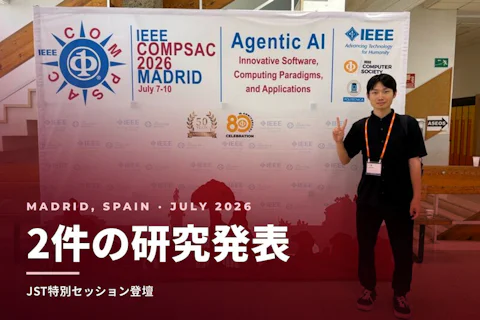
IEEE COMPSAC 2026
国際会議IEEE COMPSAC 2026(スペイン・マドリード)で2件の研究発表,JST特別セッションでの登壇
国際会議 · 2026
Real-time crowd digital twins require both fast future prediction and continuous synchronization with real-world observations. However, in agent-based simulations that run ahead of real time, newly arriving sensor data correspond to past simulation states, making full rollback and recomputation computationally infeasible under real-time constraints. To address this challenge, this paper proposes a dual-simulation framework called Lead-Chase for indoor crowd digital twins. In the proposed architecture, the Lead simulation continuously advances virtual time faster than real time to provide future predictions, while the Chase simulation selectively corrects discrepancies using delayed observation data. Instead of recomputing all agents, Chase re-simulates only agents with large prediction errors and a limited number of neighboring agents selected by a regression-based improvement estimation model. This design enables efficient data assimilation while maintaining real-time performance. The framework is implemented on Unity using a NavMesh-based mobility model and an XGBoost destination predictor trained from indoor trajectory data. Experiments were conducted using a digital twin of a university campus floor reconstructed in Unity with LiDAR-based tracking data. Results show that the proposed method consistently reduces positioning errors compared to the standalone Lead prediction, achieving more than 2.5 m improvement in mean absolute error across multiple prediction horizons. In addition, we evaluate area-level population distributions by partitioning the floor into functional areas and computing the error between the predicted and groundtruth population counts in each area, confirming that Chase improves the reproduction of spatial crowd distributions.