論文誌 · 2024
Anomaly Detection of Building Structure from Incomplete Point Cloud Obtained by UAV
Abstract
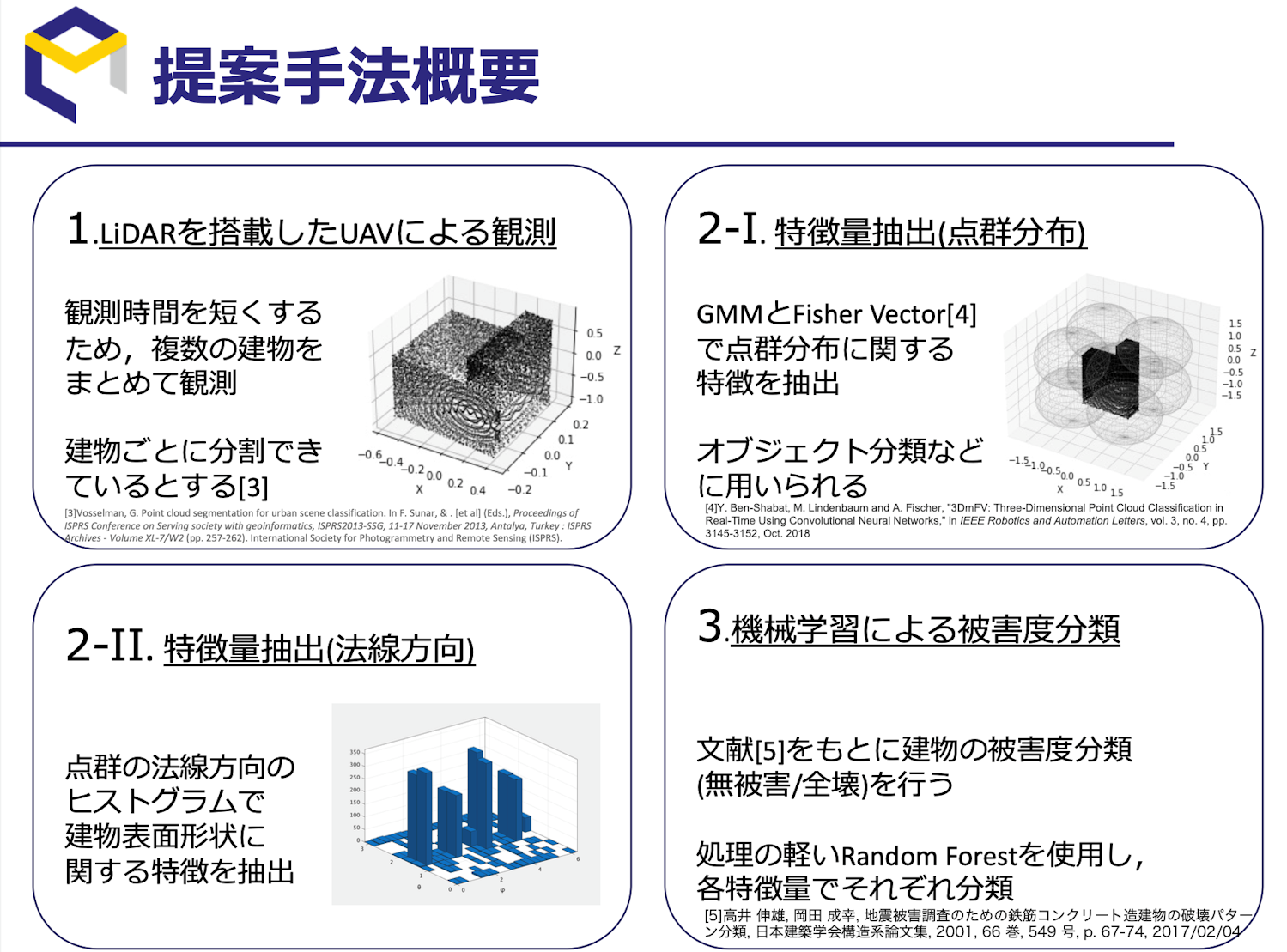
Japan has been severely impacted by natural disasters including but not limited to earthquakes such as the Great Hanshin-Awaji Earthquake in 1995 and the Kumamoto Earthquake in 2016. These seismic events have underscored the high number of casualties that result from individuals becoming trapped in collapsed buildings or affected by fires, thereby accentuating the need for building-specific earthquake assessments. Although experts have performed detailed analyses using automated satellite imagery and UAV-captured photos for longer-term objectives such as secondary disaster prevention, reconstruction, and insurance claim verification, these require a substantial amount of time to implement. This paper introduces two methods that employ UAVs to rapidly detect anomalous building structures, allowing for the simultaneous observation of multiple buildings. First, we present a method for identifying building structures from incomplete three-dimensional point clouds acquired by unmanned aerial vehicles (UAVs) that move faster over the target area in a limited time for rapid assessment. The method efficiently identifies the structural characteristics of buildings by operating under certain geometric assumptions such as the angles between building sides being approximately 90 degrees and vertical consistency in building shape. We also present a method for identifying collapsed buildings by extracting features from point clouds in Fisher vector and normal histogram and using a machine-learning model for detection. In our evaluations, we have shown that by limiting observations to less than half of the building structure, the first method can successfully recognize the geometric shape of 70% of the undamaged buildings. In the experiments for the second method, both feature extraction methods achieved a Receiver Operating Characteristic Area Under the Curve (ROC-AUC) values greater than 0.99.
解説
1995年の阪神淡路大震災や2016年の熊本地震など,日本は地震をはじめとする自然災害により多大な被害を受けてきた.これらの大地震では,倒壊や火災によって閉じ込められる事による犠牲者が多く,建物構造の異常に着目して被災状況を把握する必要性が指摘されている.現在,測量士による詳細な調査,人工衛星による自動撮影,UAVによる画像撮影などによる状況把握が行われている. しかし,これらは二次災害の防止や復興,保険適用を目的としており,多くの時間を必要とする.そこで,UAVを用いて複数の建物を同時に観測することで,迅速に建物構造の異常を検出する手法を提案する.機械学習モデルを用いて,建物の特徴量から無損傷と倒壊の分類を行う.この特徴量は,点群の分布を表すFisher Vectorと,点群に含まれる面の方向と数を表すNormal Histogramである.この特徴量は,損傷していない建物と崩壊した建物の形状の違いや,崩壊により建物表面が疎になることを利用している.評価実験の結果,両特徴ともROC-AUCは0.99以上を達成し,ノイズに対するロバスト性も示された.また,特徴抽出に要する時間,分類精度,対応可能な倒壊の程度がトレードオフの関係にあることを示す結果も得られている.
発表論文
- 原田歩, 廣森聡仁, 山口弘純, & 東野輝夫. (2021). LiDAR を用いた疎な観測による多角柱復元手法の提案. マルチメディア, 分散協調とモバイルシンポジウム 2021 論文集, 2021(1), 1400-1407.
- 原田歩, 廣森聡仁, & 山口弘純. (2021). 3D 都市モデルを対象とした点群データによる大まかな建築群復元手法の検討と評価. 研究報告高度交通システムとスマートコミュニティ (ITS), 2021(33), 1-8.
- Harada, Ayumu, Akihito Hiromori, and Hirozumi Yamaguchi. "Anomaly Detection of Building Structure from Incomplete Point Cloud Obtained by UAV." Journal of Information Processing 32 (2024): 520-532.