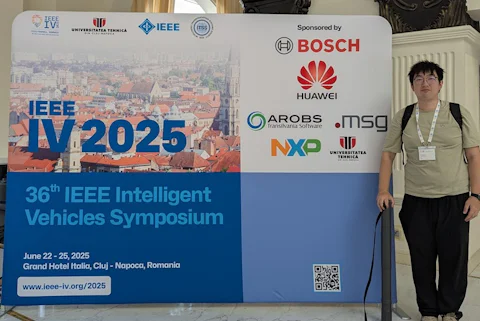
IEEE IV2025で研究発表
ルーマニア・クルジュ=ナポカで開催された国際会議IV2025においてD2のLiuが研究発表
国際会議 · 2025
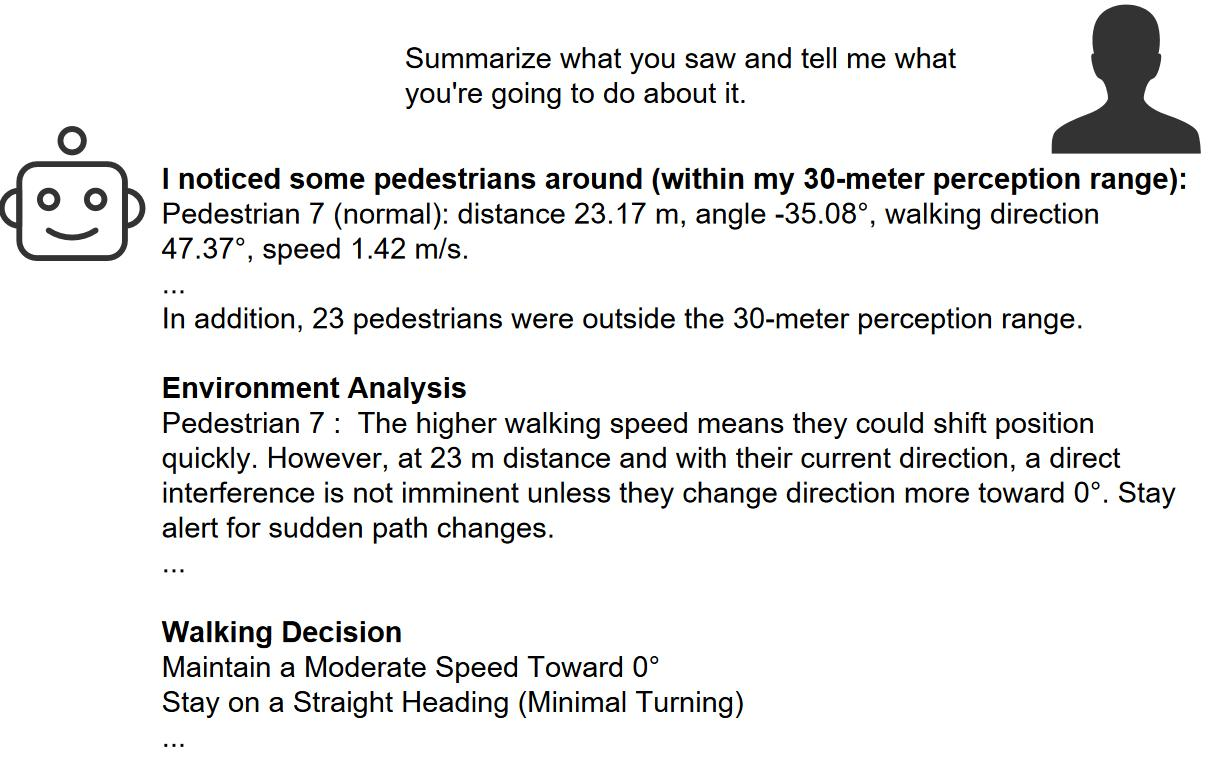
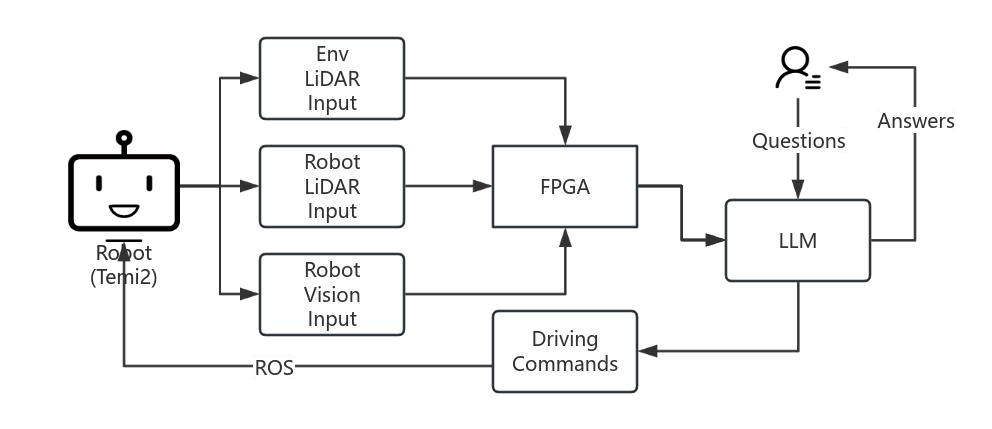
This paper presents a novel autonomous navigation framework that integrates Large Language Models (LLMs) with multimodal sensor fusion to enable dynamic obstacle avoidance and human-aware path planning in diverse environments. The proposed system leverages an FPGA-accelerated fusion pipeline, combining LiDAR and vision data for real-time perception. A Hungarian algorithm-based object matching technique ensures robust tracking, while a bird's-eye view (BEV) representation enhances spatial reasoning and occlusion handling. The fused sensory inputs are processed by a fine-tuned LLM, which contextualizes pedestrian behavior and environmental constraints to generate adaptive, human-centric navigation strategies. Unlike traditional rule-based methods, LLMs provide generalization capabilities to novel scenarios, significantly improving interaction with vulnerable pedestrians such as children, elderly individuals, and wheelchair users. Extensive evaluations in both simulated and real-world scenarios confirm the system's ability to reduce collisions and enhance navigation efficiency in high-density environments. By bridging semantic reasoning and robotic control, this work lays the foundation for next-generation intelligent navigation systems that are both safety-aware and scalable across autonomous platforms.
本研究では、駅や商業施設などの高密度で動的な環境における自律ロボットナビゲーションの課題に取り組むため、マルチモーダルセンサーデータ(LiDARと視覚センサ)の融合と大規模言語モデル(LLM)を活用した適応型ナビゲーションシステムを提案します。従来のルールベース手法では対応が困難な人間の予測不能な行動や障害物の動的変化に対処するため、FPGAによる高速データ処理とLLMを組み合わせた社会規範に基づく経路計画を実現しました。具体的には、LiDAR点群とTriple-RGBカメラデータをFPGA上でハンガリアンアルゴリズムを用いて統合し、歩行者属性(年齢、車椅子の有無)を考慮したリスク分類と優先度付けをLLMで行います。評価実験では、歩行者位置予測誤差を従来手法比40%削減し、実時間処理を可能とする低遅延性能を確認しています。今後の展開として、Q-LoRAによる推論精度向上やFPGAモジュールの独立検証を予定しています。