人や物の屋内位置情報は様々なアプリケーションに応用できると考えています.例えば,ショッピングモール,介護施設,オフィスなどで人の動きを把握したり,探し物の位置を表示したりするものを想定しています.しかし,多数の物にWi-FiやBLEの電波を発信する小型のデバイス(タグ)を取り付けることは,充電や電池交換に伴う管理の手間が問題となります.そこで本研究ではBackscatterタグの位置推定を目指して,到来角推定を行っています.
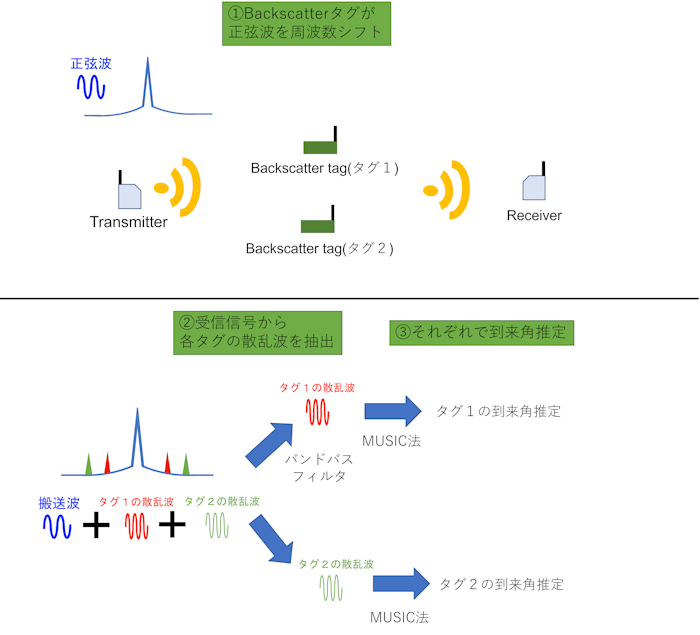
Backscatterは周囲の端末から発信されるWi-FiやBluetoothなどの電波の反射/吸収の状態を切り替えることで通信を行う技術です.Backscatterはタグ側で搬送波を生成する必要がないため,超低消費電力での通信が可能です.またBackscatterタグは周囲の電波を散乱する際に,固有の周波数シフトを生成します.各タグのシフト周波数とそれに対応するタグの設置場所の組をデータベースなどに登録しておくことで,シフト周波数に応じた対象の識別を行います.
Backscatterタグの到来角推定にあたっては,受信信号からシフト周波数成分のみを抽出する必要があります.このため,本研究ではFFT(Fast Fourier Transform)により周波数領域において受信信号を分離し,シフト周波数成分のみを抽出します.その後,IFFT(Inverse Fast Fourier Transform)により,抽出した周波数スペクトラムを時間領域信号に変換し,到来角推定アルゴリズムであるMUSIC法を適用します.
発表論文
- 山口雄大, 内山彰, & 東野輝夫. (2022). Backscatter タグを用いた MUSIC 法による到来角推定の性能評価. 研究報告高度交通システムとスマートコミュニティ (ITS), 2022(28), 1-7.
- Yamaguchi, Y., Erdélyi, V., Uchiyama, A., & Higashino, T. (2024, March). A Preliminary Study on Angle of Arrival Estimation by MUSIC Algorithm Using Backscatter Tags. In 2024 IEEE International Conference on Pervasive Computing and Communications Workshops and other Affiliated Events (PerCom Workshops) (pp. 696-701). IEEE.