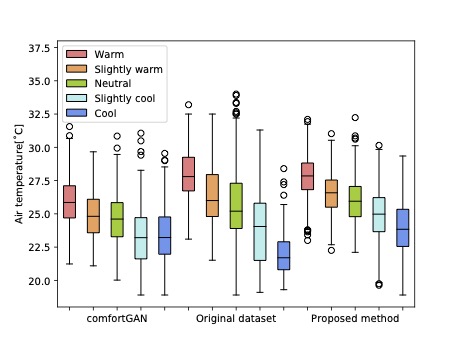
Data Balancing for Thermal Comfort Datasets Using GANs

敵対的生成ネットワークを用いた温冷感データセットの拡張手法

Data Balancing for Thermal Comfort Datasets Using GANs

Keywords

Machine learningGenerative adversarial networksData balancing


Data balancing is an essential preprocessing for proper training of thermal comfort estimators. The development of various machine learning methods helps to improve the performance of the thermal comfort estimation. However, thermal comfort datasets are usually imbalanced because hot/cold environments rarely appear in an air-conditioned environment. Imbalanced datasets lead to biased estimation, which is not helpful for users in environments that rarely appear. Therefore, many researchers have applied data augmentation for rare samples to balance thermal comfort datasets. Nevertheless, the imbalance in the original dataset still leads to biased data generation. In this study, we propose a data balancing method for thermal comfort datasets using conditional Wasserstein GAN with a weighted loss function.

  • Hiroki Yoshikawa, Akira Uchiyama, Teruo Higashino, "Data Balancing for Thermal Comfort Datasets Using Conditional Wasserstein GAN with a Weighted Loss Function," Proc. of the 8th ACM International Conference on Systems for Energy-Efficient Buildings, Cities, and Transportation (BuildSys 2021) Workshops, Coimbra, Portugal, November 17-18, 2021. doi:https://doi.org/10.1145/3486611.3491132
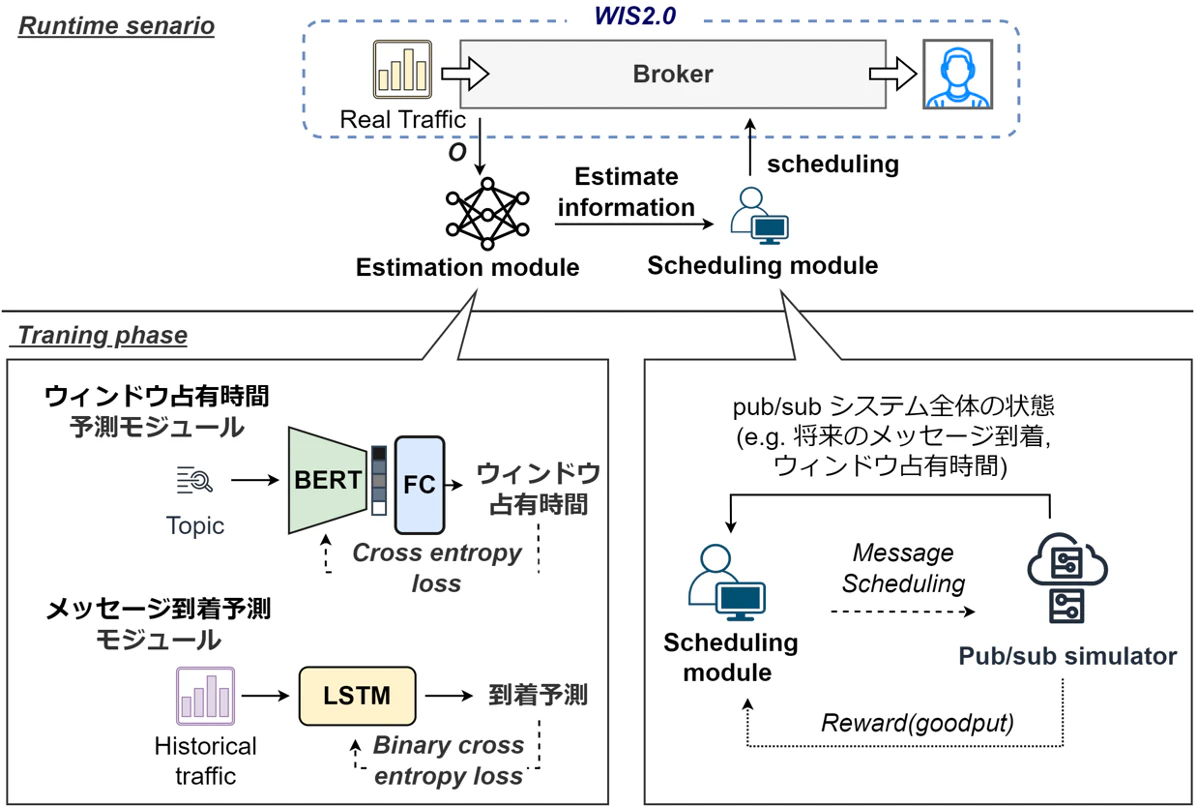
Environment-Aware Distributed Scheduling for Emergency LoRa Networks

Yuto Inaba, Tatsuya Amano, Akihito Hiromori, Hirozumi Yamaguchi

2026 IEEE International Conference on Pervasive Computing and Communications Workshops and other Affiliated Events (PerCom Workshops), SPT-IoT 2026, pp. 1366–1371

Disaster CommunicationLoRa +4

A Lightweight Vision-Language Model for Disaster Image Summarization

Hibiki Yoshizaki, Akira Uchiyama, Akihito Hiromori, Mineo Takai, Hirozumi Yamaguchi

2026 IEEE International Conference on Pervasive Computing and Communications Workshops and other Affiliated Events (PerCom Workshops), PerconAI 2026, pp. 1203–1208

Semantic CommunicationDisaster Response +4

Physics-Integrated Deep Learning for Urban Landslide Prediction

Ren Ozeki, Hamada Rizk, Hirozumi Yamaguchi

2026 IEEE International Conference on Pervasive Computing and Communications Workshops and other Affiliated Events (PerCom Workshops), URBSENSE 2026, pp. 1094–1099

Landslide PredictionPhysics-Integrated Learning +3

Ray-Tracing-Driven Pattern-Based Vehicle Recognition in ISAC Radar

Heetae Jin, Akira Uchiyama

2026 IEEE International Conference on Pervasive Computing and Communications Workshops and other Affiliated Events (PerCom Workshops), PerRad 2026, pp. 328–333

ISACBeyond 5G +4

A Simulation Framework for Precision Formation Flying of Massive Satellite Swarms

Tatsuya Amano, Akihito Hiromori, Hirozumi Yamaguchi, Sumio Morioka

2026 IEEE International Conference on Pervasive Computing and Communications Workshops and other Affiliated Events (PerCom Workshops), PerVehicle , pp. 230–235

Satellite Formation FlyingDistributed Simulation +4

A Digital Twin Approach for Crowd Flow Modeling on Railway Station Platforms

Yu Yasuda, Tatsuya Amano and Hirozumi Yamaguchi

IEEE International Conference on Smart Computing (SMARTCOMP), pp. 82-89

DOI 10.1109/SMARTCOMP65954.2025.00069

Digital TwinCrowd Simulation +1