In recent years, modern vehicles have been equipped with a growing number of sensors beyond traditional in-car systems such as navigation systems, ETC, and GPS. These sensors, including LiDAR, millimeter-wave radar, and cameras, play a crucial role in detecting pedestrians and objects around the vehicle to enhance driving safety and security. As a result, the ability to process large volumes of data from these sensors has become a critical requirement.
To handle such data efficiently, vehicles are increasingly equipped with multiple Electronic Control Units (ECUs), which are interconnected via an in-vehicle network. This network must not only be efficient but also meet diverse Quality of Service (QoS) requirements, such as latency, bandwidth, and priority levels, depending on the application demands.
One approach to managing network performance is QoS control mechanisms, including priority control and bandwidth allocation. These mechanisms allow the system to configure network switches appropriately, ensuring that the various ECUs’ requirements are effectively handled. However, determining the optimal network configuration is challenging due to the vast number of parameters involved in network control, making it difficult to derive the precise settings needed to achieve the desired network performance.
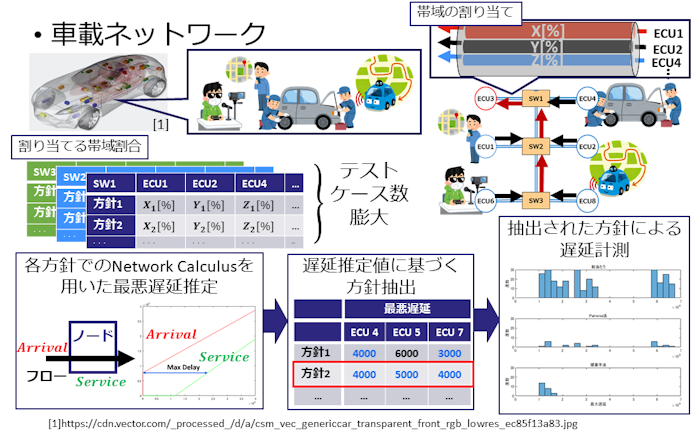
This study proposes a method to derive an optimal network control strategy when an in-vehicle network fails to meet an application's latency requirements. The proposed approach leverages Network Calculus to estimate the worst-case delay, enabling the selection of a minimal number of test cases for performance evaluation. Network Calculus is a mathematical framework used to derive worst-case delay bounds—one of the most critical metrics in network performance analysis. While it does not always yield exact latency values, it can compute delay estimates significantly faster than traditional network simulation techniques.
The proposed method utilizes worst-case delay estimates derived from Network Calculus to infer latency trends across different network control strategies. It then extracts control strategies that are likely to yield low delays and conducts simulations only on these selected test cases to measure the actual delay. By focusing on a reduced set of test cases, this approach efficiently determines a network control policy that satisfies the application’s latency requirements, improving the feasibility of real-time performance tuning in in-vehicle networks.
Published Papers
- 松田脩佑, 廣森聡仁, 山口弘純, 陶山洋次郎, 泉達也, 浦山博史, 小林史歩, 梅原茂樹, 谷英哲. (2022). 車載ネットワークを対象とした Network Calculus に基づく遅延性能評価手法. 電子情報通信学会技術研究報告; 信学技報, 122(14), 12-17. https://ken.ieice.org/ken/paper/20220512ECK4/
- 松田脩佑, 廣森聡仁, & 山口弘純. (2022). Network Calculus による最悪遅延解析を用いた遅延ボトルネック検出法. 第 84 回全国大会講演論文集, 2022(1), 375-376., https://ipsj.ixsq.nii.ac.jp/records/221358