Participated in IEEE GLOBECOM 2023
Prof. Akihito Hiromori, Prof. Hamada Rizk, and M2 student Ren Ozeki participated in IEEE GLOBECOM 2023 and presented two papers.
Publications & Talks

International Conference · 2023
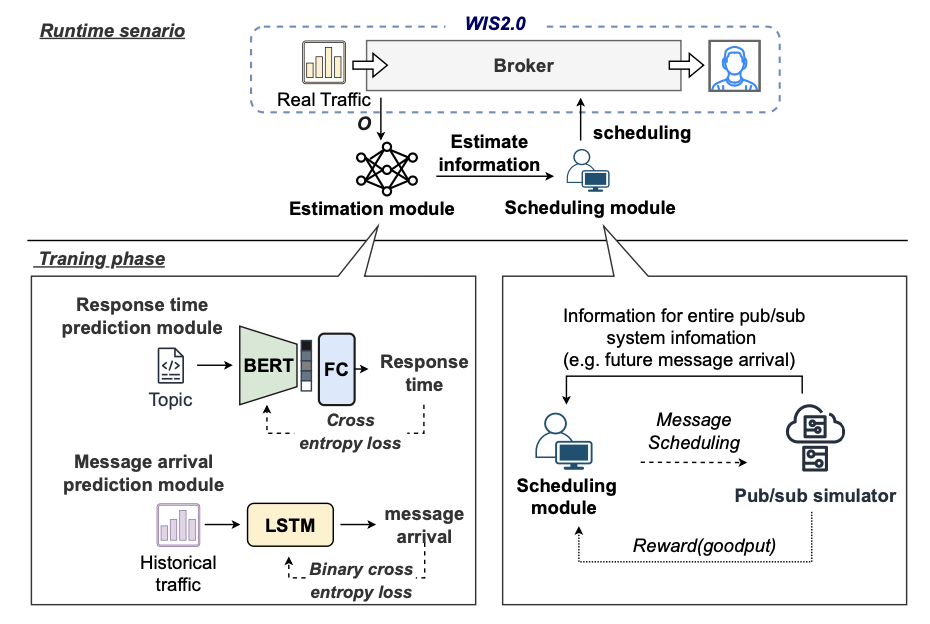
This study proposes an adaptive message delivery mechanism for a broker in the WMO Information System 2.0 (WIS2.0), a next-generation world weather loT data exchange system, to satisfy the time constraints (deadlines) of the messages requested by subscribers in the system. Since WIS2.0 is a worldwide, heterogeneous system, each broker has to handle a variety of requests by each subscriber to receive messages (data) with different time constraints and sizes. Therefore, it needs to control the timing of message delivery to subscribers, considering publishers' delivery timing, subscribers' processing performance, network bandwidth, message types, data volume, and so on. To this end, the proposed method takes a reinforcement learning-based approach where the feasible timing to transmit messages is learned by monitoring the message arrival patterns from the publishers, message ACK delay from the subscriber, and the sensing window size, all of which are easily observable at the broker. Experiments using a network simulator showed that under the best-case scenario, the proposed method could achieve 10% higher message goodput compared to DWEDF-RL, the state-of-the-art RL-based packet scheduling method tailored to the pub/sub model.
This study proposes an adaptive message delivery mechanism for a broker in the WMO Information System 2.0 (WIS2.0), a next-generation world weather IoT data exchange system, to satisfy the time constraints (deadlines) of the messages subscribers request in the system.
Since WIS2.0 is a worldwide, heterogeneous system, each broker has to handle various requests by each subscriber to receive messages (data) with different time constraints and sizes. Therefore, it needs to control the timing of message delivery to subscribers, considering publishers’ delivery timing, subscribers’ processing performance, network bandwidth, message types, data volume, and so on. To this end, the proposed method takes a reinforcement learning-based approach where the feasible timing to transmit messages is learned by monitoring the message arrival patterns from the publishers, application layer ACK (A-ACK) delay from the subscriber, and the sending window size, all of which are easily observable at the broker. Furthermore, since A-ACK depends on message contents, our method employs content-aware prediction for the response time of A-ACK utilizing a message Topic that describes message contents in natural language.
Published Papers