Adaptive Indoor Navigation System Using Human Flow Digital Twin

人流デジタルツインを活用した適応的屋内ナビゲーションシステム

Adaptive Indoor Navigation System Using Human Flow Digital Twin

Keywords

Digital twinLiDARscaniverse

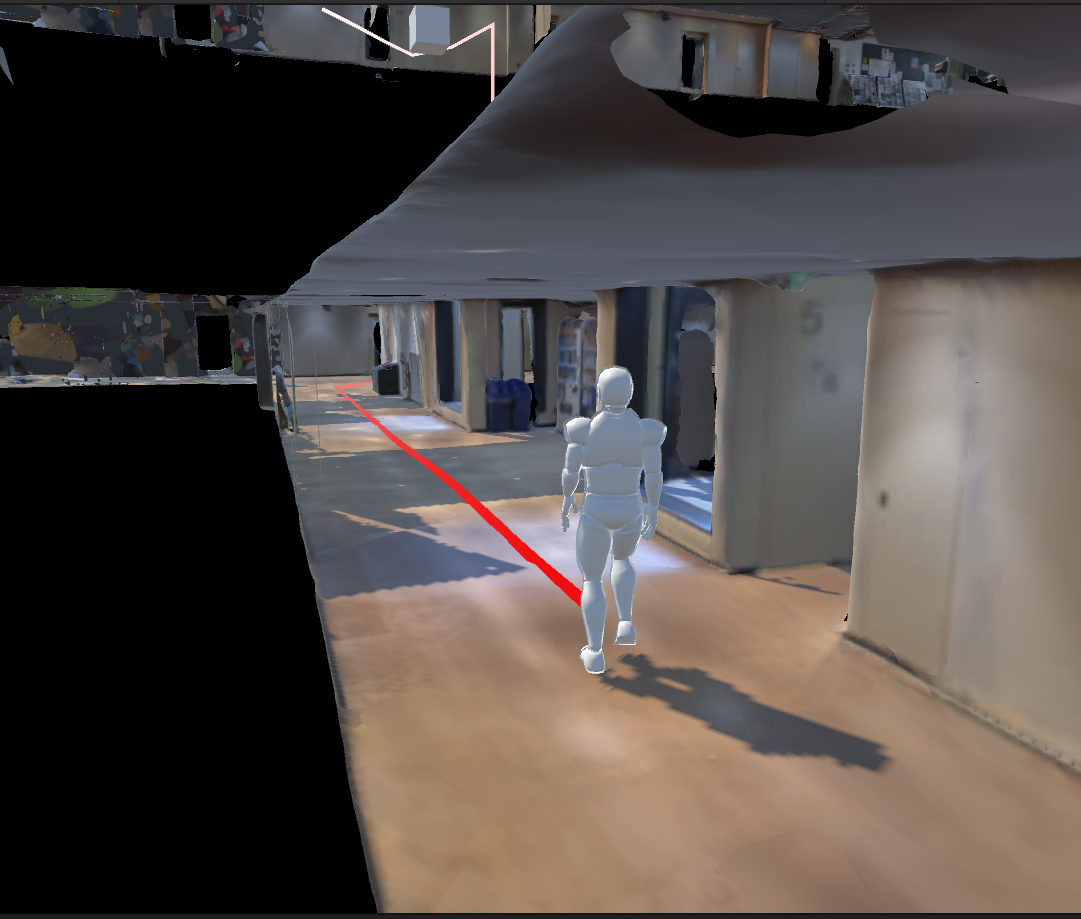
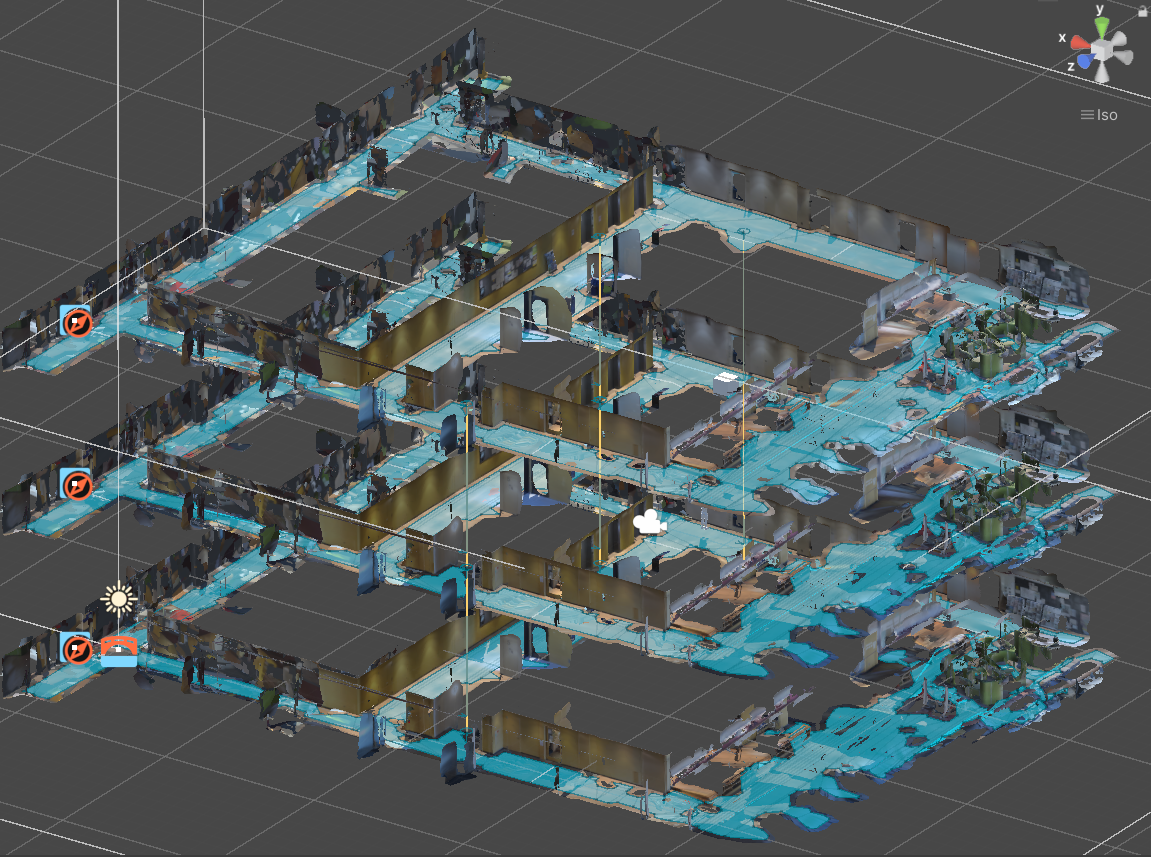
Digital twin technology is attracting attention as a technology that reproduces objects and systems in physical space in virtual space and coordinates their behaviors and states in real time. In this laboratory, as part of the development of smart city infrastructure technology, research on human flow digital twin is being conducted, and a system called “Hitonavi,” which detects and tracks the location of pedestrians in a building using LiDAR sensors, is being developed. Therefore, we propose an adaptive indoor navigation system that utilizes the human flow digital twin, which predicts human flow based on the location coordinates of pedestrians in a building obtained from Hitonavi, and reflects this information in cost values.

The system first scans a building using the scaniverse and reproduces it in Unity space. The reproduced building reflects the human flow obtained from Hitonavi. Paths are calculated in this space. A graph was created to calculate the cost of five factors that are load when people move: the density of people in the vicinity of the route, the amount of people passing each other while moving, the amount of people who must pass each other while moving, the probability of people occurring on the route while moving, and the physical distance between the route and the person. We also designed an algorithm that uses the A* algorithm to search for the route with the lowest cost on the graph.
Published Paper

  • 矢野敦大, et al. "AR ヘッドセットによる屋内ナビゲーションシステムの構築." 研究報告高度交通システムとスマートコミュニティ (ITS) 2024.8 (2024): 1-1.
Environment-Aware Distributed Scheduling for Emergency LoRa Networks

Yuto Inaba, Tatsuya Amano, Akihito Hiromori, Hirozumi Yamaguchi

2026 IEEE International Conference on Pervasive Computing and Communications Workshops and other Affiliated Events (PerCom Workshops), SPT-IoT 2026, pp. 1366–1371

Disaster CommunicationLoRa +4

A Lightweight Vision-Language Model for Disaster Image Summarization

Hibiki Yoshizaki, Akira Uchiyama, Akihito Hiromori, Mineo Takai, Hirozumi Yamaguchi

2026 IEEE International Conference on Pervasive Computing and Communications Workshops and other Affiliated Events (PerCom Workshops), PerconAI 2026, pp. 1203–1208

Semantic CommunicationDisaster Response +4

Physics-Integrated Deep Learning for Urban Landslide Prediction

Ren Ozeki, Hamada Rizk, Hirozumi Yamaguchi

2026 IEEE International Conference on Pervasive Computing and Communications Workshops and other Affiliated Events (PerCom Workshops), URBSENSE 2026, pp. 1094–1099

Landslide PredictionPhysics-Integrated Learning +3

Ray-Tracing-Driven Pattern-Based Vehicle Recognition in ISAC Radar

Heetae Jin, Akira Uchiyama

2026 IEEE International Conference on Pervasive Computing and Communications Workshops and other Affiliated Events (PerCom Workshops), PerRad 2026, pp. 328–333

ISACBeyond 5G +4

A Simulation Framework for Precision Formation Flying of Massive Satellite Swarms

Tatsuya Amano, Akihito Hiromori, Hirozumi Yamaguchi, Sumio Morioka

2026 IEEE International Conference on Pervasive Computing and Communications Workshops and other Affiliated Events (PerCom Workshops), PerVehicle , pp. 230–235

Satellite Formation FlyingDistributed Simulation +4

A Digital Twin Approach for Crowd Flow Modeling on Railway Station Platforms

Yu Yasuda, Tatsuya Amano and Hirozumi Yamaguchi

IEEE International Conference on Smart Computing (SMARTCOMP), pp. 82-89

DOI 10.1109/SMARTCOMP65954.2025.00069

Digital TwinCrowd Simulation +1