Human Activity Recognition (HAR) using Wi-Fi Channel State Information (CSI) offers a device-free and cost-effective solution for applications in healthcare, smart homes, and security. However, CSI-based HAR faces challenges due to environmental factors like device positions and room layouts, which affect signal propagation and lead to variations in CSI data. These variations make it difficult to develop models that generalize well across different environments.
This study proposes a deep learning-based HAR system that utilizes CSI data from multiple environments to improve recognition accuracy, even in unseen settings. The system employs a multi-task learning approach with an encoder-decoder network to extract environment-invariant representations, reducing the impact of environmental changes.
To evaluate the method, CSI data were collected from six activities performed by three participants in four environments. The proposed approach achieved an average accuracy of 66%, marking a 17% improvement over a Support Vector Classifier. Additionally, Few-Shot Learning enabled activity recognition with up to 77% accuracy using a small amount of data from an unseen environment. These results highlight the effectiveness of deep learning in achieving environment-independent HAR.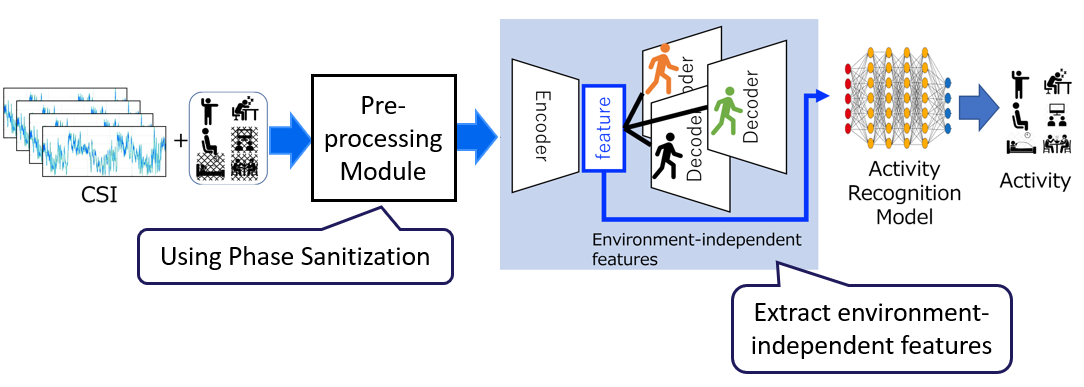
Published Papers
- 杉本雄, 内山彰, and 山口弘純. "Encoder-Decoder Network による Wi-Fi CSI を用いた環境非依存な行動認識手法の検討." マルチメディア, 分散, 協調とモバイルシンポジウム 2023 論文集 2023 (2023): 1204-1209.
- 杉本雄, 内山彰, and 山口弘純. "環境非依存な Wi-Fi CSI 行動認識に向けたオフセット軽減手法の有効性評価." マルチメディア, 分散, 協調とモバイルシンポジウム 2024 論文集 2024 (2024): 709-715.
- Sugimoto, Yu, et al. "Towards environment-independent activity recognition using wi-fi CSI with an encoder-decoder network." Proceedings of the 8th Workshop on Body-Centric Computing Systems. 2023.https://dl.acm.org/doi/abs/10.1145/3597061.3597261