Performance Evaluation of Angle of Arrival Estimation by MUSIC Method Using Backscatter Tags

Backscatterタグを用いたMUSIC法による到来角推定の性能評価

Performance Evaluation of Angle of Arrival Estimation by MUSIC Method Using Backscatter Tags

Keywords

BackscatterWi-Fi

Indoor positioning of people and objects has potential applications in various fields, such as shopping malls, nursing homes, and offices. Possible use cases include tracking human movement and displaying the location of lost items. However, attaching small devices (tags) that actively transmit Wi-Fi or BLE signals to numerous objects poses challenges in terms of maintenance, such as charging and battery replacement. Therefore, this study aims to estimate the position of Backscatter tags by performing angle of arrival (AoA) estimation.
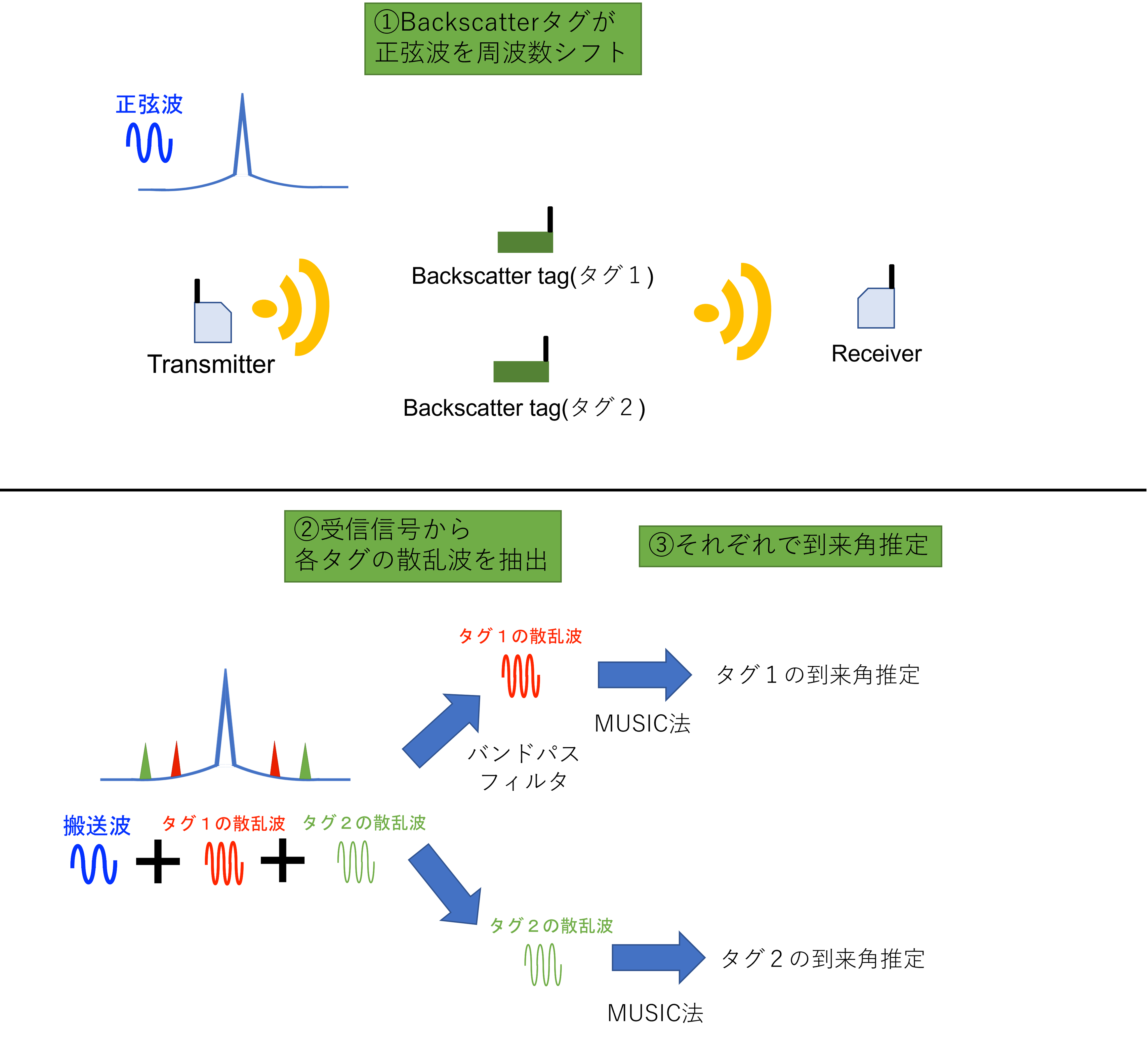
Backscatter is a communication technology that switches between reflecting and absorbing ambient signals from nearby Wi-Fi or Bluetooth devices. Since Backscatter does not require the tag to generate its own carrier signal, it enables ultra-low-power communication. Additionally, when Backscatter tags scatter ambient signals, they generate unique frequency shifts. By registering pairs of shift frequencies and their corresponding tag locations in a database, it is possible to identify objects based on their frequency shifts.
For angle of arrival estimation of Backscatter tags, it is necessary to extract only the shift frequency components from the received signals. To achieve this, this study applies Fast Fourier Transform (FFT) to separate the received signals in the frequency domain and extract only the shift frequency components. Then, Inverse Fast Fourier Transform (IFFT)is used to convert the extracted frequency spectrum back into a time-domain signal, after which the MUSIC (Multiple Signal Classification) algorithm is applied for angle of arrival estimation.


Published Papers

  • 山口雄大, 内山彰, & 東野輝夫. (2022). Backscatter タグを用いた MUSIC 法による到来角推定の性能評価. 研究報告高度交通システムとスマートコミュニティ (ITS)2022(28), 1-7.
  • Yamaguchi, Y., Erdélyi, V., Uchiyama, A., & Higashino, T. (2024, March). A Preliminary Study on Angle of Arrival Estimation by MUSIC Algorithm Using Backscatter Tags. In 2024 IEEE International Conference on Pervasive Computing and Communications Workshops and other Affiliated Events (PerCom Workshops) (pp. 696-701). IEEE.
Environment-Aware Distributed Scheduling for Emergency LoRa Networks

Yuto Inaba, Tatsuya Amano, Akihito Hiromori, Hirozumi Yamaguchi

2026 IEEE International Conference on Pervasive Computing and Communications Workshops and other Affiliated Events (PerCom Workshops), SPT-IoT 2026, pp. 1366–1371

Disaster CommunicationLoRa +4

A Lightweight Vision-Language Model for Disaster Image Summarization

Hibiki Yoshizaki, Akira Uchiyama, Akihito Hiromori, Mineo Takai, Hirozumi Yamaguchi

2026 IEEE International Conference on Pervasive Computing and Communications Workshops and other Affiliated Events (PerCom Workshops), PerconAI 2026, pp. 1203–1208

Semantic CommunicationDisaster Response +4

Physics-Integrated Deep Learning for Urban Landslide Prediction

Ren Ozeki, Hamada Rizk, Hirozumi Yamaguchi

2026 IEEE International Conference on Pervasive Computing and Communications Workshops and other Affiliated Events (PerCom Workshops), URBSENSE 2026, pp. 1094–1099

Landslide PredictionPhysics-Integrated Learning +3

Ray-Tracing-Driven Pattern-Based Vehicle Recognition in ISAC Radar

Heetae Jin, Akira Uchiyama

2026 IEEE International Conference on Pervasive Computing and Communications Workshops and other Affiliated Events (PerCom Workshops), PerRad 2026, pp. 328–333

ISACBeyond 5G +4

A Simulation Framework for Precision Formation Flying of Massive Satellite Swarms

Tatsuya Amano, Akihito Hiromori, Hirozumi Yamaguchi, Sumio Morioka

2026 IEEE International Conference on Pervasive Computing and Communications Workshops and other Affiliated Events (PerCom Workshops), PerVehicle , pp. 230–235

Satellite Formation FlyingDistributed Simulation +4

A Digital Twin Approach for Crowd Flow Modeling on Railway Station Platforms

Yu Yasuda, Tatsuya Amano and Hirozumi Yamaguchi

IEEE International Conference on Smart Computing (SMARTCOMP), pp. 82-89

DOI 10.1109/SMARTCOMP65954.2025.00069

Digital TwinCrowd Simulation +1