This project has been selected for the Japan Science and Technology Agency (JST) Strategic Basic Research Programs (PRESTO), under the research area “[Social Transformation Platform] Co-Creation of the Transformation Platform Technology for Human and Society by Integration of the Humanities and Sciences.”
In cities, people move every day for a wide range of purposes—commuting to work or school, sightseeing, shopping, and attending events. These flows of people affect road and public-transport congestion, the vitality of commercial and tourist areas, and even public safety and evacuation during disasters. For this reason, local governments, transportation operators, and urban planners have long used transportation and pedestrian-flow simulations to examine in advance how the dynamics of a city might change if policies or operations were modified.
The value of simulation lies not only in predicting whether congestion will increase or decrease, but also in enabling “virtual trials” of multiple options—such as timetable revisions, road and infrastructure design, event operations, and information provision (guidance and crowd management)—to support decision-making. Because large-scale experiments are often infeasible in real urban environments, simulation serves as a critical foundation for evaluating interventions before implementing them in the real world.
At the same time, the accuracy of such simulations ultimately depends on how realistically they can represent human decision-making and movement. Conventional transportation and pedestrian-flow simulations typically model behavior using predefined rules or statistical distributions. In reality, however, people’s movements are strongly shaped by context—weather, perceived congestion, companions, familiarity with an area, schedule changes, and information from social media or word of mouth. Even for the same individual, decisions may vary: “I’m in a hurry today,” “I’ll take a different route because it seems crowded,” or “I’ll stop by somewhere on the way.” Such context-dependent decision-making is difficult to capture with fixed rules or average distributions alone, which in turn makes it hard to explain why particular movement patterns emerged.
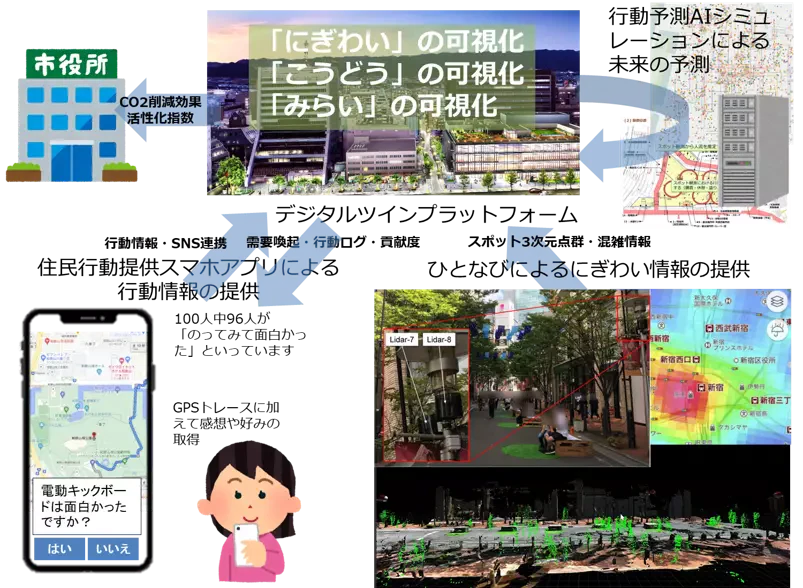
In this project (a JST PRESTO-selected research topic), we aim to develop a simulation platform that can more deeply understand and reproduce human behavior in urban settings by leveraging the advanced reasoning capabilities and world knowledge of large language models (LLMs). We introduce foundation models such as LLMs as models of human behavior and work toward reproducing flexible decision-making that adapts to context and situations. Furthermore, by integrating real-world data obtained from pedestrian-flow sensing with LLM-based inference of behavioral intent, we aim to build a framework that can interpret the intentions and purposes underlying observed mobility patterns.
By establishing this platform, we expect to make it easier to explain and evaluate not only how people moved in response to changes in urban conditions, but also why they moved that way—thereby improving the practical usefulness of simulation for decision-making related to congestion mitigation, enhanced circulation and visitation, event operations, and disaster preparedness.