Project Overview
This project, titled "Research and Development of Narrow Multi-Beam Forming Technology for Frequency Sharing in Direct Communication between LEO Satellites and Ground Terminals," was selected under the Ministry of Internal Affairs and Communications' "Research and Development for Radio Resource Expansion" program. Led by Interstellar Technologies Inc., five universities are collaborating: Iwate University, Osaka University, Tokyo Institute of Technology, Nara Institute of Science and Technology, and Niigata University.
In recent years, there has been growing interest in communication services utilizing Low Earth Orbit (LEO) satellites. Compared to geostationary satellites, LEO satellites enable low-latency and broadband communications, with expectations for "Direct to Device (D2D)" communication that allows ordinary terminals such as smartphones to communicate directly with satellites. However, the frequency bands used by conventional smartphones differ from those used by satellites, making the establishment of frequency sharing technology essential for D2D communication.
Research Goals
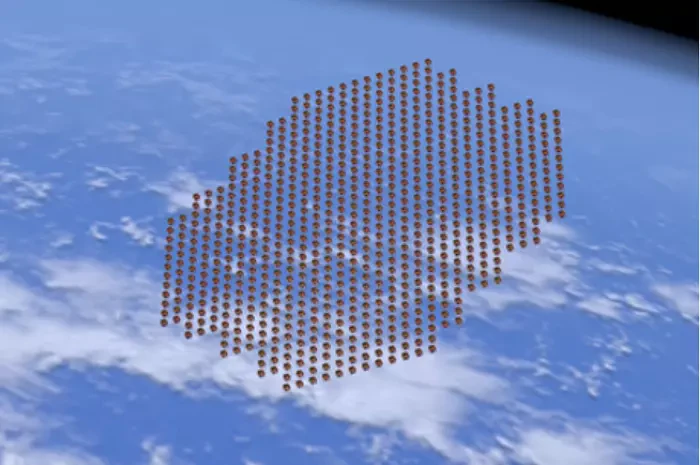
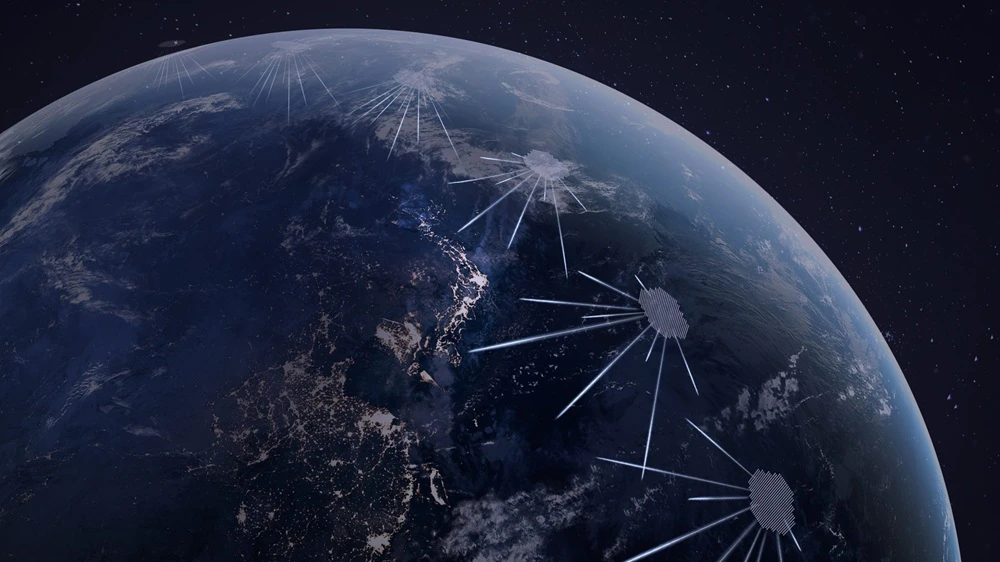
This research aims to establish fundamental technologies for enabling formation flying of multiple ultra-small satellites to function as a single large antenna. Specifically, the project focuses on high-precision radio wave directional control through narrow multi-beam forming, establishment of wireless and information processing technologies between satellites, and frequency sharing technology with existing ground-based wireless systems.
Through these technologies, we aim to achieve high-speed, high-capacity, and multiple simultaneous connections equivalent to terrestrial communication networks. The outcomes of this project are expected to enable next-generation satellite communication without dedicated antennas, allowing smartphones to communicate directly with satellites even in areas where communication infrastructure is not developed.
Role of Yamaguchi Laboratory
Yamaguchi Laboratory at Osaka University is responsible for research and development of evaluation and simulation technologies for satellite swarm antenna systems using formation flying. We are working on communication performance evaluation when multiple satellites operate cooperatively, and optimization of beam forming algorithms.