This project, titled "Development of Formation Flying Technology for Precise Control of Large-Scale Satellite Swarms," was selected under the JAXA Space Strategy Fund theme of "High-Precision Satellite Formation Flying Technology," with Interstellar Technologies Inc. as the lead organization.
What is Satellite Formation Flying?
In recent years, small, low-cost spacecraft such as microsatellites and CubeSats have attracted significant attention. Compared to conventional large satellites, these offer reduced launch costs and greater flexibility in design, manufacturing, and operation, making them promising for a wide range of applications including communications and remote sensing.
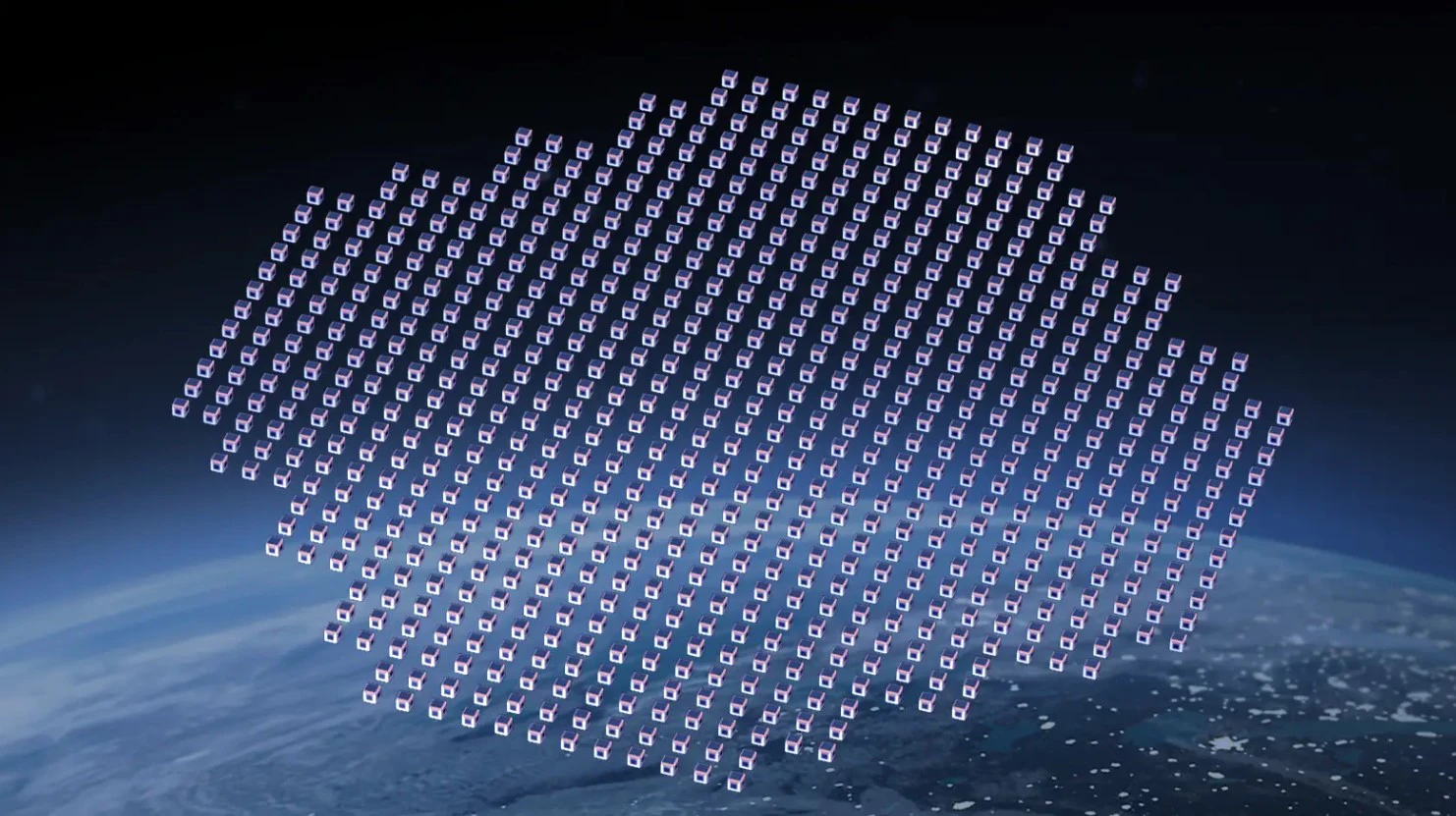
Formation flying technology enables multiple small satellites to fly cooperatively, providing advanced capabilities that cannot be achieved by a single satellite. By complementing each other's power and functional limitations, multiple satellites can function as if they were a single large satellite.
Project Goals
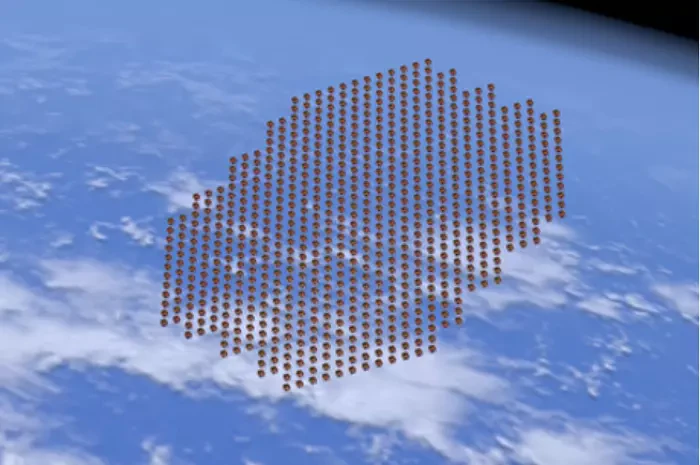
This project aims to establish technology for formation flying of 1,000 to 100,000 ultra-small satellites in LEO (Low Earth Orbit), maintaining relative distances at centimeter-level precision while positioned within a range of several tens of meters. Each satellite is equipped with electromagnets, enabling precise position control through mutual attraction and repulsion.
This technology will enable the construction of high-gain antennas spanning hundreds of square meters in space, making next-generation broadband satellite communications possible where ordinary terminals such as smartphones can communicate directly with satellites. Applications in remote sensing and scientific observation, such as parallel sensing and wide-area simultaneous observation using multiple satellites, are also anticipated.
Partner Institutions
With Interstellar Technologies Inc. as the lead organization, five universities are collaborating on this research and development: Institute of Science Tokyo, Nara Institute of Science and Technology, Osaka University, Shonan Institute of Technology, and University of Aizu.
Development of High-Precision Evaluation System for Control Algorithms
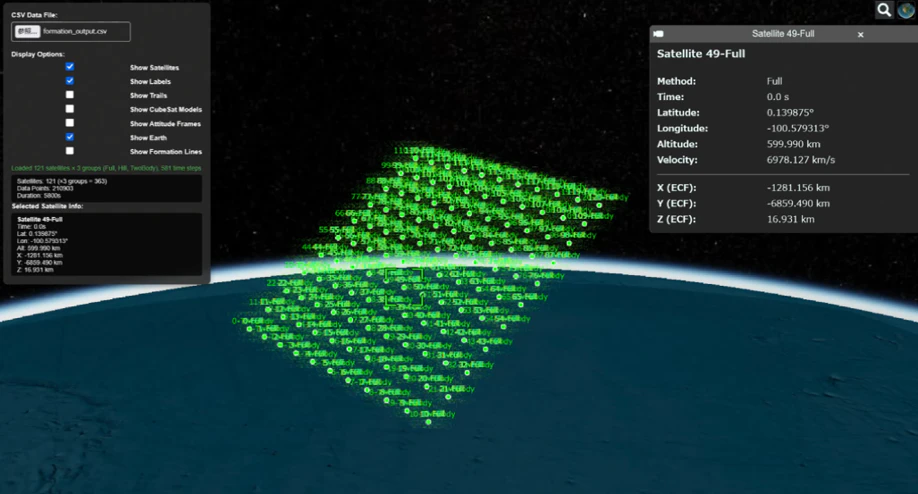
Osaka University is responsible for developing an integrated simulation system to evaluate formation flying control algorithms with high precision.
Conventional formation flying research has been limited to configurations of only a few satellites, and evaluation technologies for coordinated operation of satellite swarms numbering in the thousands to tens of thousands have not yet been established. Multi-satellite formation flying requires precise prediction of spacecraft behavior in space while comprehensively considering hardware constraints of relative distance control mechanisms and the effects of orbital disturbances.
The integrated simulator being developed by Osaka University provides an environment for comprehensive evaluation of control algorithms by integrating high-precision orbital dynamics calculations including perturbations in the LEO environment, reproduction of relative position and attitude measurements considering error characteristics of various sensors, and modeling of inter-satellite interactions through electromagnetic coils. Furthermore, through large-scale parallel computing utilizing the supercomputer "Fugaku" at the RIKEN Center for Computational Science, we aim to achieve simulations of satellite swarms numbering in the thousands or more.